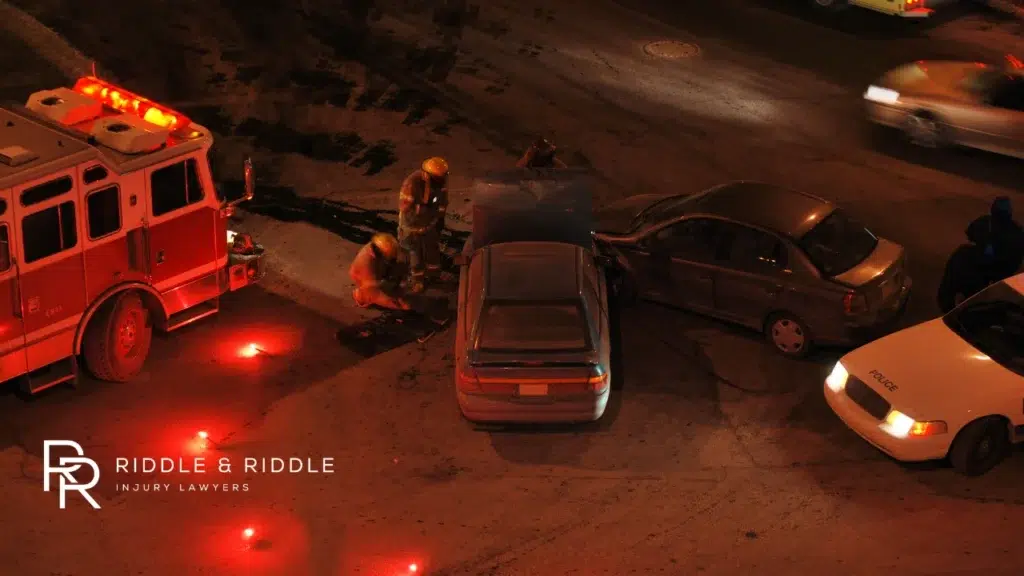
North Carolina's Contributory Negligence System & Crucial Exceptions
To understand why proving fault requires meticulous evidence, you must first understand North Carolina’s strict personal injury liability laws.
The 1% Fault Bar (Pure Contributory Negligence)
North Carolina is one of only four states (along with Alabama, Maryland, Virginia, and Washington, D.C.) that still enforces pure contributory negligence. Under the state’s rules governing what constitutes contributory negligence, even 1% of shared blame can legally bar an injured driver from recovering a single dollar from the at-fault driver’s insurance company.
Insurance adjusters frequently manipulate statements and physical evidence to assign minor blame to injury victims, using contributory negligence as a weapon to issue immediate claim denials.
Exception 1: The "Last Clear Chance" Doctrine
Even if an injured driver was initially negligent (such as being stuck in an intersection or making an improper turn), they may still recover damages under North Carolina’s Last Clear Chance doctrine.
To succeed under this exception, your attorney must prove four key legal elements:
You negligently placed yourself in a position of danger.
You were unable to escape or avoid the impending danger.
The defendant driver knew—or should have known—that you were in danger and unable to escape.
The defendant driver had the physical time and ability to avoid hitting you but failed to act with reasonable care.
Exception 2: Gross Negligence / Willful and Wanton Conduct
Contributory negligence does not bar recovery if the at-fault driver acted with gross negligence or willful and wanton conduct, meaning a conscious, reckless disregard for the safety of others.
Example: If you were driving 5 mph over the speed limit (simple negligence) and were slammed into by a driver going 90 mph while intoxicated or engaged in aggressive road rage, the court views the other driver’s behavior as gross negligence. This gross negligence overrides your minor speeding, allowing you to recover full financial compensation.
Key Evidence Used to Establish Fault in an NC Crash
Building an airtight liability claim requires collecting multiple layers of physical, digital, and testimonial evidence immediately following an accident. Securing proper personal injury evidence quickly prevents physical proof from being lost or destroyed.
The primary types of evidence used by personal injury lawyers to prove fault include:
Official Police Crash Reports: Contains the investigating officer’s initial observations, diagrams, citations issued, and statements from involved parties.
Eyewitness Testimony: Independent statements from bystanders, occupants of other vehicles, or nearby pedestrians who witnessed the collision unfolding.
Dashcam and Security Footage: Visual proof captured by vehicle dashcams, nearby business surveillance systems, or municipal traffic cameras.
Cell Phone Records: Subpoenaed mobile carrier records demonstrating that a driver was texting, browsing, or calling at the exact time of impact.
Vehicle Black Box (EDR) Data: Event Data Recorders inside passenger cars and commercial trucks that log pre-crash speed, braking force, steering angle, seatbelt usage, and throttle position.
Toxicology & Chemical Testing: Police BAC tests proving a driver was operating under the influence of alcohol or controlled substances.
Can Vehicle Damage Alone Determine Fault?
A common question crash victims ask is whether physical damage to the vehicles can definitively prove who was at fault.
The short answer is yes, vehicle damage provides vital clues—but damage alone is rarely enough without supporting evidence.
Video Transcript
To prove fault, there are a lot of different things that we do as your attorney. We look at the accident report. We talk to the officer. We’ll talk to any witnesses that saw anything. And sometimes we’ll even hire accident reconstructionists to help establish liability.
How Impact Locations Reveal Crash Dynamics
Automotive engineers and accident investigators analyze vehicle crush points to piece together how a collision occurred:
Passenger-Side Impact (T-Bone): Severe side-door crushing paired with front-end damage on the second vehicle strongly indicates a failure to yield at an intersection or running a red light/stop sign.
Rear-End Collisions: Front-end damage on one vehicle and rear bumper damage on another typically creates a presumption of fault against the trailing driver for tailgating, distracted driving, or speeding.
Sideswipe Damage: Longitudinal scrapes along vehicle side panels indicate improper lane changes, blind-spot collisions, or sideswipe incidents in dual-turn lanes.
Limitations of Relying Solely on Vehicle Damage
While damage patterns show where impact occurred, they cannot always tell the full story:
Multi-Vehicle Pileups: Chain-reaction collisions make it difficult to determine which vehicle initiated the initial impact without analyzing sequence data.
Rollover Accidents: Severe structural roof crush and multi-directional damage obscure the initial point of collision.
Disputed Signal Lights: Structural damage cannot reveal whether a traffic signal was red or green at the time both vehicles entered the intersection.
Because vehicle damage has limitations, attorneys combine physical vehicle inspections with skid mark measurements, debris field analysis, and expert crash reconstruction.
How an Accident Reconstructionist Can Help Your Claim
In catastrophic, complex, or disputed car accident cases, hiring an accident reconstructionist can make the difference between a complete denial of a claim and a multi-million-dollar recovery.
Accident reconstructionists are forensic engineers, former law enforcement crash investigators, or physicists who apply scientific principles to determine how an accident occurred.
| Reconstruction Tool / Technique | How It Helps Prove Liability |
| Black Box / EDR Analysis | Extracts precise electronic data logging vehicle speed, braking, and engine RPM in the 5 seconds leading up to impact. |
| 3D Laser Scanning & Drone Mapping | Captures millimeter-accurate digital measurements of the crash scene, roadway curvature, signage, sightlines, and gouge marks. |
| Crush Energy & Delta-V Calculations | Uses physics and vehicle mass calculations to determine the exact speed and change in velocity (Delta-V) at the moment of impact. |
| 3D Computer Animations | Converts complex physics and engineering data into clear, visual 3D video simulations presented to insurance adjusters, mediators, or jury panels. |
By translating technical physical evidence into compelling visual proof, an accident reconstructionist neutralizes false claims made by the at-fault driver or defense experts.
Why You Should Never Admit Fault After a Car Accident
In the immediate aftermath of a collision, shock, confusion, and adrenaline can impair your judgment. Many people feel a natural urge to apologize or explain what happened.
Admitting fault or making ambiguous statements is one of the most damaging mistakes you can make.
Dangerous Statements to Avoid at the Scene
Even well-intentioned or polite remarks can be recorded in police notes and seized upon by insurance adjusters as an admission of legal guilt:
❌ “I’m sorry.” While intended as polite sympathy, insurers interpret an apology as an admission of guilt and remorse for causing the crash.
❌ “I didn’t see the other car.” This phrase suggests to adjusters that you were distracted, inattentive, or failing to keep a proper lookout behind the wheel.
❌ “It was my fault” / “I made a mistake.” Explicitly accepting blame creates an immediate paper trail that can destroy your legal rights under NC’s pure contributory negligence rule.
What You Should Do Instead
Remain Calm and Check for Injuries: Ensure everyone’s safety and call emergency medical services immediately.
Stick Strictly to Fact-Based Details: When speaking to law enforcement, describe what happened objectively (e.g., “I was driving straight in the right lane when the other car entered my lane”) without speculating on speed or fault.
Document the Scene: Take photos of vehicle damage, license plates, skid marks, traffic signals, weather conditions, and visible injuries.
Refuse Recorded Statements to Adjusters: Never agree to provide a recorded statement to the other driver’s insurance company before consulting an attorney.
Seek Experienced Legal Representation: Let your lawyer manage all communications with insurance adjusters to protect you from misinterpretation.
Financial Damages Available When Liability Is Established
Once liability is established against the negligent driver, you are entitled to recover both economic and non-economic damages under North Carolina personal injury law:
Medical Expenses: Coverage for emergency room care, hospitalizations, surgeries, physical therapy, prescription drugs, and projected future medical treatment.
Lost Income & Reduced Earning Capacity: Compensation for missed work hours, lost bonuses, and long-term reduction in earning potential due to permanent disability.
Vehicle Repair or Replacement: Out-of-pocket costs to repair your vehicle or recover its actual cash value if deemed a total loss.
Pain and Suffering: Compensation for physical pain, emotional distress, anxiety, post-traumatic stress disorder (PTSD), and loss of enjoyment of life.
How Riddle & Riddle Injury Lawyers Proves Fault in Complex North Carolina Crashes
Proving fault under North Carolina’s unforgiving contributory negligence system requires vast investigative resources, experienced attorneys, and aggressive legal advocacy.
When you retain a North Carolina car accident lawyer from Riddle & Riddle Injury Lawyers, your claim is backed by over 171 years of combined legal experience. Our firm’s history about us highlights our dedicated team of in-house investigators who immediately deploy to crash scenes to locate video footage, interview witnesses, and preserve physical evidence before it disappears.
Call Riddle & Riddle Injury Lawyers today at 800-525-7111 or contact us online to schedule your free, no-obligation case evaluation. We are available 24/7 by phone, email, text, or video conference to fight for the justice you deserve.