


How North Carolina Calculates Weekly Workers' Compensation Benefits
Under the statutory framework of the North Carolina Workers’ Compensation Act, wage replacement benefits are designed to approximate an injured worker’s net take-home pay prior to the accident. Because workers’ compensation checks are not subject to state or federal income taxes, receiving two-thirds of your gross income helps match your pre-injury net pay.
The Standard Average Weekly Wage (AWW) Formula
For employees who have worked for their employer for at least 52 weeks prior to the injury, calculating the Average Weekly Wage (AWW) involves dividing gross earnings over the preceding 52 weeks by 52.

Calculating Benefits for New Employees: The "Comparable Employee" Method
If an employee has worked for less than 52 weeks—or just a few days—applying a standard average would unfairly undercount their true earning potential.
In these situations, North Carolina law allows injured workers to calculate their benefit rate using the earnings of a “comparable employee.” A comparable employee is a coworker in the same job position who has been with the company for a year or longer.
Real-World Example: Correcting an Improper Wage Calculation
The Scenario: Jane was hired as a sales associate in Raleigh at $20/hour for her first 30 hours per week, with an agreement that her hours would ramp up to 40 hours plus overtime during busy seasons, along with eligibility for year-end bonuses.
The Injury: During her second week on the job, a co-worker dropped a heavy crate, fracturing bones in Jane’s hand that required emergency surgery.
The Insurance Error: The workers’ comp insurance adjuster sent Jane a weekly benefit check for only $100, basing the rate on her brief, part-time training hours rather than her full earning potential.
The Legal Correction: A North Carolina workers’ compensation lawyer intervened, invoking the comparable employee rule. By examining the 52-week payroll records of a seasoned associate holding the same title, Jane’s AWW was recalculated to include seasonal overtime and holiday bonuses. Furthermore, weeks where the comparable employee took unpaid vacation were removed from the denominator, substantially raising Jane’s weekly benefit checks.
Does Surgery Increase Your Workers' Compensation Settlement?
While there is no fixed “bonus” paid simply for undergoing a medical procedure, having surgery almost always increases the overall settlement value of a workers’ compensation claim.
Surgeries fundamentally alter the financial scale of a claim across several key areas:
| How Surgery Alters Claim Valuation | Impact on Settlement Amount |
| Increased Medical Expenses | Operating room fees, surgeon fees, anesthesiology fees, inpatient hospital stays, prescription medications, and months of postoperative physical therapy substantially increase the total medical costs paid by the insurer. |
| Extended Temporary Total Disability (TTD) | Surgical recovery and rehabilitation require significantly more time off work, extending the duration of weekly wage replacement checks. |
| Higher Permanent Impairment Ratings | Once maximum medical improvement (MMI) is reached, physicians assign a Permanent Partial Disability (PPD) rating. Surgical interventions (such as spinal fusions, joint replacements, or hardware installations) generally result in higher permanent loss-of-function percentages under state schedules. |
| Future Medical Needs & Work Restrictions | Post-surgical clients frequently require long-term care, future hardware removal, or permanent light-duty work restrictions that limit earning capacity. |
Does Workers' Compensation Pay for Pain and Suffering in NC?
A common point of confusion for injured employees is whether they can claim damages for physical pain, emotional anguish, or loss of enjoyment of life.
Under standard North Carolina workers’ compensation law, benefits do NOT cover pain and suffering.
Workers’ compensation is a “no-fault” compromise system: employees receive guaranteed coverage for medical expenses and wage loss without having to prove their employer was negligent, but in exchange, they give up the right to sue their employer for general personal-injury damages such as pain and suffering.
Standard Benefits Provided Under Workers' Comp
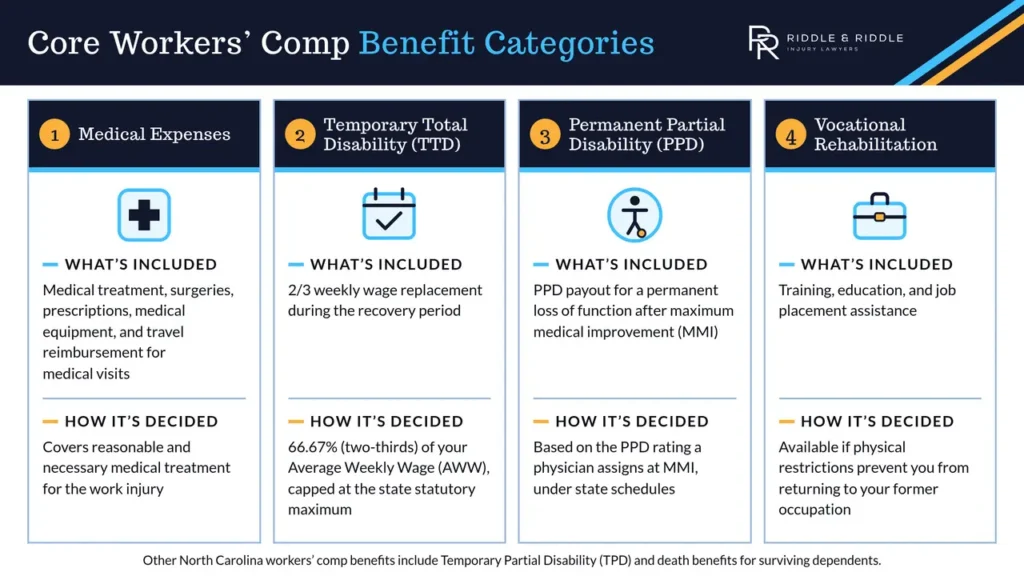
Medical Costs: 100% coverage for reasonable and necessary medical treatment, surgeries, prescriptions, medical equipment, and travel reimbursement for medical visits.
Disability & Wage Replacement: Temporary Total Disability (TTD), Temporary Partial Disability (TPD), or Permanent Partial Disability (PPD) payments.
Vocational Rehabilitation: Training, education, and job placement assistance if physical restrictions prevent you from returning to your former occupation.
Death Benefits: Weekly financial support and funeral expense coverage provided to surviving dependents following a fatal workplace accident.
The Third-Party Exception: How to Recover Pain and Suffering
While you cannot recover pain and suffering from your employer, you can seek full pain and suffering damages if your workplace injury was caused by the negligence of an outside third party.
Motor Vehicle Collisions: If you drive a vehicle for work (such as a delivery driver or traveling sales representative) and are rear-ended by a negligent driver, you can collect workers’ comp benefits and file a personal injury lawsuit against the at-fault driver for full pain and suffering.
Defective Machinery & Equipment: If a workplace machine or power tool malfunctions due to a manufacturing or design defect, you can pursue a product liability claim against the equipment manufacturer.
Subcontractor Negligence: If a worker from another company on a multi-employer construction site causes an accident that injures you, a third-party claim can be brought against that subcontractor.
Protecting Your Rights Against Insurance Company Tactics
Insurance carriers frequently use aggressive tactics to minimize workers’ comp payouts, such as issuing lowball Average Weekly Wage determinations, pressuring doctors to issue premature light-duty releases, or denying necessary surgical procedures.
Injured workers should be aware of common tricks insurance companies use to avoid paying injury claims. Working with an experienced legal team ensures your rights are protected throughout the dispute process.
Overlap with Social Security Disability Benefits
When a severe workplace injury results in long-term or permanent disability that prevents you from engaging in substantial gainful activity for 12 months or longer, you may qualify for both workers’ compensation and federal disability benefits. Consulting a North Carolina Social Security disability lawyer helps coordinate these benefits to avoid costly offset reductions.
Contact Our NC Workers' Compensation Lawyers Today
I am completely satisfied with the result of my [workers’ comp] case.
Lakeisha D., Riddle & Riddle client
If you were injured on the job, do not let an insurance carrier undercalculate your wages or deny you the full settlement you deserve.
Call Riddle & Riddle Injury Lawyers today at 800-525-7111 or contact us online to schedule your free, no-obligation case evaluation. We are available 24/7 by phone, text, email, or video conference to stand up for your rights.