

Key Factors That Influence Your NC Truck Accident Case Timeline
Unlike standard passenger car collisions, commercial truck accidents involve massive vehicles traveling at high speeds, complex federal safety regulations, and corporate insurance policies carrying multi-million-dollar limits. As a result, insurance companies investigate these claims aggressively to minimize their payouts.
Several primary elements dictate how long your case will take from start to finish:
| Timeline Factor | How It Impacts Case Duration |
| Severity of Physical Injuries | Severe injuries require months of ongoing treatment, surgeries, and rehabilitation before long-term prognosis can be determined. |
| Medical Record Collection Delays | Gathering comprehensive billing and treatment records from multiple hospital systems and specialists often takes several months. |
| Volume of Commercial Evidence | Subpoenaing and analyzing electronic logging devices (ELDs), black box recorders, and trucking company hiring files takes time. |
| Disputed Fault / Multiple Defendants | When trucking companies, cargo loaders, and maintenance contractors shift blame, extra time is needed for accident reconstruction. |
| Insurance Negotiation Tactics | Defense adjusters often intentionally delay negotiations or issue lowball offers to pressure injured victims into settling early. |
Why Seeking Immediate Medical Care Is Critical to Your Health and Timeline
If you are involved in a collision with an 18-wheeler, the single most important action you can take immediately after the crash is to see a qualified medical professional for a comprehensive evaluation.
Even if you believe your injuries are minor or you are experiencing an adrenaline rush that masks pain, prompt medical evaluation is essential for two distinct reasons:
Identifying Latent and Life-Threatening Injuries
The immense kinetic force transferred during a truck collision frequently causes severe internal trauma that may not display symptoms right away. Emergency medical personnel and physicians evaluate crash victims for hidden conditions, including:
Traumatic brain injuries requiring emergency neurological intervention.
Latent closed-head trauma, like concussion injuries, that worsen over days or weeks.
Severe spinal damage, herniated discs, or permanent paralysis stemming from a spinal cord injury.
Internal organ damage, internal bleeding, and complex bone fractures.
Building the Medical Evidence Chain for Your Claim
From a legal standpoint, your medical records serve as the cornerstone of your injury claim. Seeking treatment immediately creates an official, timestamped record that directly links your physical injuries to the truck accident.
If you delay seeing a doctor for days or weeks after a crash, defense insurance adjusters will claim that your injuries were not serious, were caused by an unrelated event, or were pre-existing conditions.
Medical Recovery and Reaching Maximum Medical Improvement (MMI)
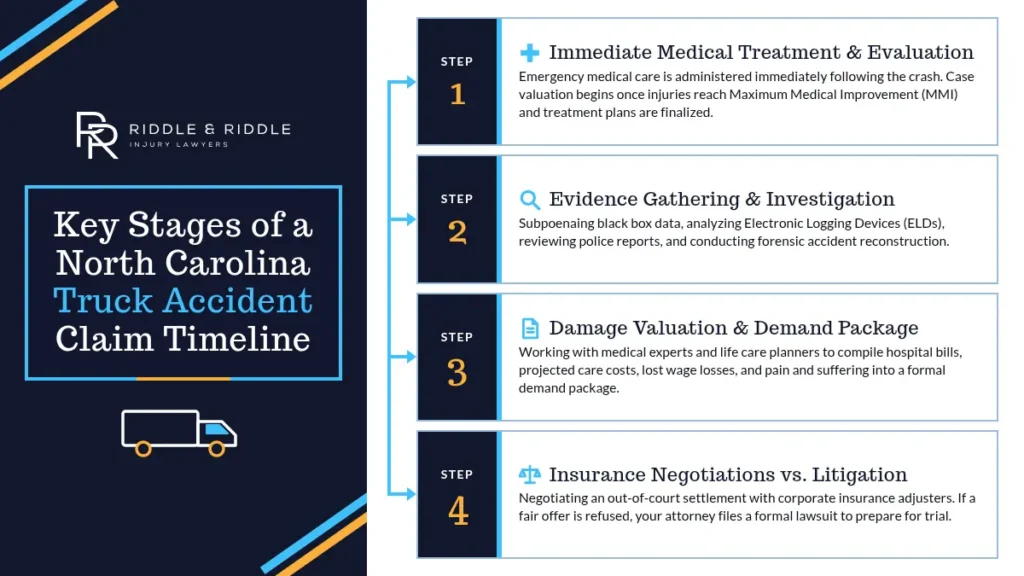
One of the main reasons a truck accident claim cannot be settled immediately is that your attorney must wait until you reach Maximum Medical Improvement (MMI).
MMI is the point in your medical recovery where your treating physicians determine that your condition has stabilized and no further significant recovery is expected—even if you are left with permanent disabilities.
Why Settling Before MMI Is Dangerous
If you agree to a settlement offer before reaching MMI, you forfeit your right to ask for additional money later. If your doctor discovers months after the crash that you require spinal fusion surgery or lifelong physical therapy, you cannot reopen your claim to demand coverage for those expenses.
Developing Comprehensive Life Care Plans
For victims facing catastrophic, long-term impairments, attorneys work alongside medical specialists and certified life care planners to project future healthcare expenses, ongoing rehabilitation, specialized equipment, home modifications, and lost earning potential. Accurately evaluating how to recover lost wages after an accident ensures that your future financial needs are fully accounted for before settlement demands are issued.
Investigating Commercial Truck Accidents and Preserving Evidence
Proving liability in a North Carolina commercial trucking case requires collecting and analyzing far more evidence than a standard passenger vehicle crash.
Securing key personal injury evidence quickly is essential because trucking companies and their insurance carriers deploy rapid-response legal teams to crash scenes within hours to protect their interests.
Essential commercial truck evidence includes:
Event Data Recorders (Black Boxes): Electronic modules logging pre-impact speed, braking force, throttle position, and engine RPM.
Electronic Logging Devices (ELDs): Digital driver logs proving whether the truck driver violated federal Hours of Service (HOS) safety limits.
Commercial Vehicle Inspection & Maintenance Logs: Records showing whether the truck suffered from deferred brake maintenance, worn tires, or steering defects.
Forensic Reconstruction & GPS Data: Drone mapping, 3D laser scans of skid marks, debris field patterns, and satellite positioning data.
When defense teams refuse to turn over black box data voluntarily, your attorney must file formal spoliation letters and emergency court orders to preserve the evidence before it is overwritten or destroyed.
Preparing the Demand Package and Combating Insurance Tactics
Once your medical treatment is complete or your future care plan is established, your attorney compiles all diagnostic records, medical bills, wage loss documentation, and expert reports into a formal demand.
Understanding what is the demand stage and what is a demand package helps explain why this phase is critical to setting up successful settlement negotiations.
What Can You Recover in an NC Truck Accident Claim?
Determining what you can sue for in a truck accident claim requires evaluating both economic and non-economic damages, including:
Past and future medical bills, hospitalizations, and surgeries.
Lost income, missed bonuses, and diminished earning capacity.
Physical pain, emotional distress, PTSD, and physical impairment.
Property damage repair or vehicle replacement costs.
Shielding You from Insurance Delay Tactics
Commercial insurance carriers frequently engage in prolonged stalling tactics, hoping financial strain will force injured workers to accept quick, lowball settlement offers. Having an experienced attorney protects you against the common tricks insurance companies use to avoid paying injury claims.
Settlement Negotiations vs. Formal Court Litigation
Once a demand package is submitted to the insurance company, the case enters active settlement negotiations.
Out-of-Court Settlement (3 to 12 Months): If the insurance carrier acts in good faith and agrees to offer a fair settlement reflecting your full damages, your case can resolve without stepping foot inside a courtroom.
Formal Litigation & Trial (1 to 2+ Years): If the trucking company denies liability or refuses to issue a reasonable offer, your attorney will file a lawsuit. Litigation involves formal court pleadings, written discovery, depositions, pre-trial motions, and a jury trial. While litigation extends the timeline, it is often necessary to secure full justice.
How Riddle & Riddle Injury Lawyers Can Help
Navigating a commercial truck accident claim while trying to physically heal can feel overwhelming. At Riddle & Riddle Injury Lawyers, our legal team brings over 171 years of combined experience fighting for crash victims across North Carolina.
We maintain a dedicated team of in-house investigators—including retired law enforcement officers—who deploy immediately to secure crash scene evidence, subpoena black box data, and protect your rights.
For a FREE consultation, please call (855) 652-2049, and let’s review your North Carolina truck accident claim. There are no upfront costs and you won’t pay any attorney fees unless we recover compensation for you. No win, no fee — it’s as simple as that.
It was nice to see Riddle & Riddle put me and my needs first.
R. Colley, Riddle & Riddle client
We believe Justice Counts for victims of truck accidents in North Carolina, and we would love to help however we can.