
North Carolina Car Accident Lawyer
Were you hurt in a car accident in North Carolina? If someone else’s negligence caused your crash, you may be entitled to compensation for your medical bills and other damages. At Riddle & Riddle Injury Lawyers, our North Carolina car accident lawyers can help you navigate your claim and hold the at-fault party accountable.
Home | North Carolina Personal Injury Lawyer | North Carolina Car Accident Lawyer

Table of Contents
- Why Choose Riddle & Riddle Injury Lawyers After a Car Accident in North Carolina?
- Types of Car Crashes We Handle in North Carolina
- What Compensation Can I Recover After a Car Crash in North Carolina?
- Car Accident Statistics in North Carolina
- How Much is My North Carolina Car Accident Case Worth?
- How Much Does It Cost to Hire a North Carolina Car Accident Lawyer?
- What if I’m Being Blamed for My Car Accident in North Carolina?
- What Causes Most Car Accidents in North Carolina?
- Common Car Accident Injuries in North Carolina
- How Long Do I Have to File a Car Accident Lawsuit in North Carolina?
- What Should I Do After a Car Accident in North Carolina?
- Car Accident FAQs
- Contact Our North Carolina Car Accident Lawyers Today for a Free Consultation
With over 171 years of combined legal experience, our law firm has helped countless crash victims throughout the state, recovering hundreds of millions of dollars in verdicts and settlements. We’re ready to put that experience to work for you.
Contact us today for a free case consultation with one of our experienced attorneys. We work on a contingency fee basis; you only pay attorney fees if we win.
Why Choose Riddle & Riddle Injury Lawyers After a Car Accident in North Carolina?
We understand the physical, emotional, and financial strain that comes with being involved in a car accident. Our team will guide you through every step of the process, ensuring that you receive the compensation you deserve. We approach each case with meticulous care and attention to detail, and our focus is always on achieving the best possible outcome for you.
When you hire Riddle & Riddle Injury Lawyer, you get:
- Free Case Review and Consultation
We start with a free, no-obligation consultation where we listen to your side of the story. This allows us to assess the details of your accident and determine the best course of action. You don’t have to meet us in person; we offer phone, text, and video consultations for your convenience. - Thorough Investigation
Once we take on your case, our experienced team conducts a thorough investigation. This includes gathering evidence, interviewing witnesses, and consulting with experts. We leave no stone unturned to build a strong case on your behalf. - Negotiation with Insurance Companies
We will negotiate with the insurance company on your behalf, ensuring you don’t fall victim to low-ball settlement offers. Our team is skilled at handling insurance tactics and will fight for a fair settlement that reflects the true value of your injuries and damages. - Litigation, If Necessary
If the insurance company is unwilling to offer a fair settlement, we are fully prepared to take your case to trial. Our experienced attorneys will advocate for you in court, providing a strong legal strategy to secure the compensation you deserve. - Maximizing Your Compensation
Throughout the entire process, our goal is to ensure you receive maximum compensation. This includes reimbursement for medical bills, lost wages, pain and suffering, property damage, and any other costs related to your accident.
By working with a skilled North Carolina auto collision attorney from Riddle & Riddle, you can trust that your case will be handled with the utmost care and professionalism. We are committed to securing the best possible results for our clients, and our experience, insight, and thorough approach set us apart. We understand how North Carolina’s laws work and what it takes to build a successful car accident claim. We’re committed to helping you recover full and fair compensation.
Call our law firm today to schedule a free case review with a North Carolina car accident attorney.
Types of Car Crashes We Handle in North Carolina
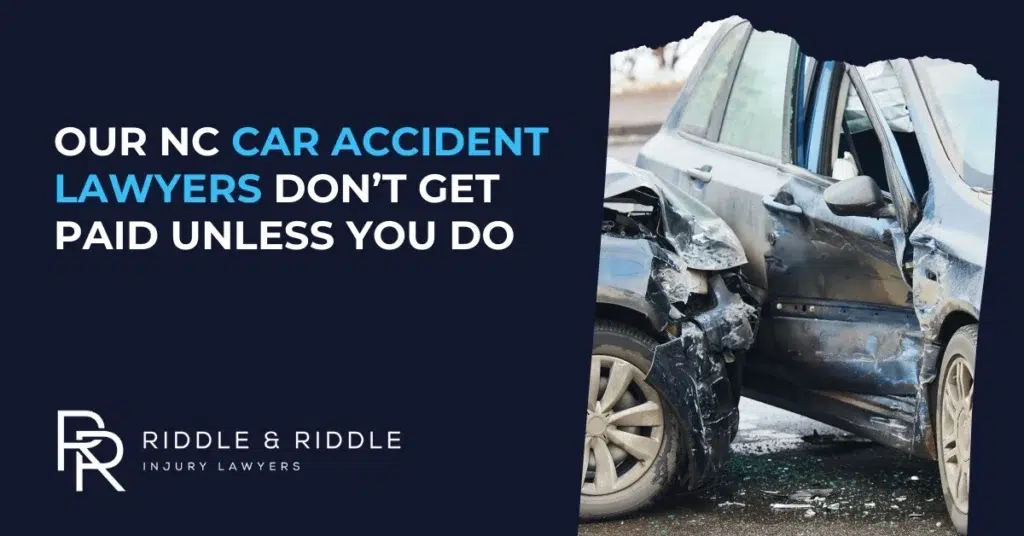
A car accident can shatter your sense of security in an instant, leaving you to deal with physical pain and the stress of a damaged vehicle. Whether your crash happened during a hectic commute in Charlotte, on a rural highway near Goldsboro, or at a busy Raleigh intersection, the specific mechanics of your collision dictate the legal strategy required to secure your recovery.
At Riddle & Riddle, we move beyond the police report to reconstruct exactly what happened, ensuring the insurance company cannot downplay the impact of your crash. We handle a wide range of collision types across North Carolina, including:
- Rear-End Collisions: Often the result of distracted driving on congested routes like I-40 or I-85, these impacts frequently cause whiplash and latent spinal injuries. In North Carolina, there is often a presumption of negligence against the following driver, and we work to ensure their insurer pays the full value of your long-term medical needs.
- Head-On Collisions: These are among the most catastrophic accidents, often occurring on two-lane North Carolina backroads or due to wrong-way drivers. Because the force of impact is doubled, the injuries are often life-altering; our team acts quickly to preserve black box data and physical evidence from the scene.
- Side-Impact (T-Bone) Accidents: Usually occurring at intersections when a driver runs a red light or fails to yield, these crashes offer very little protection to passengers. We have deep experience navigating the “he-said, she-said” nature of intersection disputes in growing hubs like Durham and Fayetteville.
- Rollover Accidents: These violent crashes often involve SUVs or vans and can be caused by tripped curbs or sudden maneuvers. We investigate these cases not just for driver error, but for potential vehicle defects or hazardous road maintenance that may have contributed to the flip.
- Multi-Vehicle Pileups: When three or more cars are involved, insurance companies quickly begin “finger-pointing” to avoid payment. We step in as your lead advocate, managing the complex web of multiple insurers to protect your right to compensation.
- Distracted & Impaired Driving Crashes: Whether caused by a driver texting on a busy city street or operating under the influence, these accidents are 100% preventable. We hold these drivers accountable by aggressively pursuing phone records and toxicology reports to prove gross negligence.
No matter how your accident occurred, the path to justice starts with an advocate who understands the local courts and North Carolina’s specific traffic laws. Contact us today for a free case review and let us guide you through the legal process with the care and dedication you deserve.
What Compensation Can I Recover After a Car Crash in North Carolina?
Under North Carolina law, accident victims can pursue both economic damages and non-economic damages. These damages help cover your financial and personal losses, attempting to “make you whole” in the process.
Your compensation award may include money for:
- Medical bills (emergency care, surgery, hospital stays, physical therapy)
- Future medical expenses for ongoing treatment
- Lost income from time off work
- Loss of future earning capacity
- Property damage (car repair or replacement)
- Pain and suffering
- Emotional distress
- Loss of enjoyment of life
- Permanent disability or disfigurement
- Loss of consortium (in wrongful death or serious injury cases)
We work with medical professionals, economists, and accident reconstruction experts to document your losses and determine the full impact of your injuries. We ensure you know the extent of your damages, so you can demand full financial justice from the insurance company.
Car Accident Statistics in North Carolina
Car accidents continue to be a leading cause of injury and death in North Carolina. In the most recent year, the state recorded 284,546 total crashes, a slight 0.1% increase from the previous year. These accidents resulted in 1,732 fatalities, marking a 2.7% increase in the number of deaths from 2023. Additionally, 113,602 people were injured, a 1.2% decrease from the previous year.
Some key insights from these statistics include:
- 11% of all crashes involved out-of-state drivers.
- 7% of all drivers killed were from out of state.
- 72% of all crashes occurred between 7:00 a.m. and 6:59 p.m., showing the high volume of accidents during daylight hours.
- 21.4% of fatalities were related to speeding, highlighting the dangers of reckless driving.
These numbers underscore the significant risks that drivers face on North Carolina’s roads every day, emphasizing the importance of cautious driving and the role of experienced attorneys in navigating the aftermath of a car accident.
How Much Is My North Carolina Car Accident Case Worth?
Every car accident case is different.
There’s no set formula for calculating your compensation, but several key factors can influence how much your claim is worth:
- The severity of your injuries
- Whether you’ll need long-term medical care or rehabilitation
- The amount of time you’ve missed from work
- Whether you’re permanently disabled or unable to return to your job
- The extent of your pain and suffering
- Property damage to your vehicle
- Available insurance coverage from all parties
- Whether fault is clearly established or disputed
The best way to determine the full value of your case is to consult with a car accident lawyer in North Carolina. At Riddle & Riddle Injury Lawyers, we can help you evaluate your case and determine its value—so you don’t settle for less than you deserve.
How Much Does It Cost to Hire a North Carolina Car Accident Lawyer?
At Riddle & Riddle, we work on a contingency fee basis, which means clients don’t pay anything upfront. Instead of charging hourly rates or requiring a retainer, the attorney’s fee is a percentage of the compensation recovered in the case, usually between 33% and 40%. If no compensation is awarded, the client typically owes nothing for legal services.
This arrangement allows injured victims to access legal representation without taking on financial risk during an already difficult time. Additionally, most lawyers cover the initial costs of investigating and building the case, including expert fees and filing expenses, and are only reimbursed if the case is successful.
We offer contingency fees in all car accident cases. Call us today to learn more about our fee arrangements.
What If I’m Being Blamed for My Car Accident in North Carolina?
North Carolina is one of only a few states that still follows the contributory negligence rule. Under this harsh rule, you may be barred from recovering any compensation if you are found even 1% at fault for the crash.
Insurance companies use this to their advantage. If they can pin partial blame on victims, they can deny or reduce their payouts. That’s why it’s critical to have an experienced attorney in your corner to challenge contributory fault allegations.
Our legal team will investigate your crash, gather evidence, and work with experts to prove that the other party was entirely at fault.

What Causes Most Car Accidents in North Carolina?
In most cases, car crashes are the result of negligence. When drivers make careless or reckless decisions behind the wheel, they put everyone around them at risk. Understanding the underlying cause of your accident is critical because it determines who can be held liable and how your case is built.
Distracted Driving
Distracted driving is one of the leading causes of crashes throughout North Carolina. Drivers who text, adjust their GPS, eat, or otherwise take their attention off the road can cause devastating collisions in a matter of seconds. These types of crashes often result in serious injuries, and our attorneys regularly represent victims of distracted driving accidents caused by negligent motorists.
Speeding and Aggressive Driving
Speeding reduces a driver’s ability to react to sudden changes in traffic conditions and significantly increases the force of impact during a crash. Aggressive driving behaviors such as weaving between lanes, tailgating, and road rage make accidents far more likely. High-speed collisions frequently occur on major highways and interstates, where victims may suffer catastrophic injuries in highway accidents.
Drunk Driving and Drug-Impaired Driving
Drivers under the influence of alcohol or drugs have impaired judgment, slower reaction times, and reduced coordination. These preventable crashes often result in severe or fatal injuries. Our firm aggressively represents victims injured by intoxicated drivers and helps families affected by drunk driving accidents pursue full compensation.
Failure to Yield and Intersection Violations
Many crashes occur when drivers fail to yield the right of way or ignore traffic signals. Running red lights, rolling through stop signs, or turning improperly can lead to dangerous side-impact collisions. These incidents frequently happen at busy intersections, and victims of intersection accidents may face serious injuries and complex liability disputes.
Tailgating or Following Too Closely
Tailgating significantly increases the risk of a crash because drivers do not leave enough distance to stop safely. Even at moderate speeds, rear-end impacts can cause painful and lasting injuries. We regularly help victims recover compensation after rear-end collisions caused by inattentive or aggressive drivers.
Unsafe Lane Changes and Multi-Vehicle Crashes
Improper lane changes and failure to check blind spots can cause chain-reaction crashes involving multiple vehicles. These collisions often involve complicated insurance claims and shared liability issues. Our attorneys have extensive experience handling multi-vehicle accidents and protecting clients from being unfairly blamed.
Fatigue and Driver Inattention
Fatigued drivers may experience slower reaction times and impaired judgment similar to intoxicated drivers. Fatigue is especially common among commercial drivers and those traveling long distances. These crashes can be particularly dangerous because fatigued drivers may fail to brake or take evasive action.
Weather Conditions and Road Hazards
Rain, fog, ice, and poorly maintained roads can contribute to accidents by reducing visibility and traction. While weather conditions play a role, drivers are still responsible for adjusting their speed and driving safely under hazardous conditions.
Many accidents have multiple causes. It’s critical to identify each factor that led to your collision. That way, you can hold responsible parties accountable for your injuries.
Free Case Review
If you’ve been involved in a car accident, it’s crucial to understand your rights. Riddle & Riddle is here to guide you through the process and help you secure the compensation you deserve.

Common Car Accident Injuries in North Carolina
Car accidents can cause a wide range of injuries, from relatively minor conditions to permanent disabilities and fatal trauma. The severity of your injuries often depends on the type of crash, the speed of impact, and the vulnerability of vehicle occupants.
Whiplash and Soft Tissue Injuries
Whiplash and other soft tissue injuries are common in crashes involving sudden impact, particularly in rear-end collisions. These injuries can cause chronic pain, limited mobility, and long-term discomfort even when symptoms do not appear immediately.
Broken Bones and Fractures
The force of a crash can easily fracture bones in the arms, legs, ribs, or pelvis. These injuries may require surgery, physical therapy, and months of recovery. High-impact crashes such as head-on collisions frequently result in severe fractures.
Neck and Back Injuries
Neck and spinal injuries, including herniated discs and nerve damage, can cause long-lasting pain and disability. These injuries are especially common in high-speed crashes and multi-vehicle impacts where the body absorbs significant force.
Traumatic Brain Injuries
Traumatic brain injuries (TBIs) can occur when the head strikes a hard surface or experiences sudden acceleration and deceleration. TBIs may cause cognitive impairment, memory loss, and permanent neurological damage.
Spinal Cord Injuries and Paralysis
Damage to the spinal cord can result in partial or complete paralysis. These catastrophic injuries often occur in severe crashes such as highway accidents and rollover collisions.
Internal Injuries and Organ Damage
Internal bleeding and organ damage may not be immediately visible but can be life-threatening without prompt medical care. These injuries often require emergency treatment and ongoing medical monitoring.
Burns and Disfigurement
Vehicle fires, explosions, and contact with hot surfaces can cause severe burns. These injuries may result in permanent scarring, nerve damage, and emotional trauma.
Fatal Injuries and Wrongful Death
Tragically, some crashes result in loss of life. Families who lose loved ones in fatal car accidents may have the right to pursue wrongful death claims to recover compensation and hold negligent parties accountable.
If you suffered these or other injuries, you could be entitled to substantial compensation. At Riddle & Riddle, we understand the emotional, physical, and financial toll these injuries take. We’re here to help you get justice.
How Long Do I Have to File a Car Accident Lawsuit in North Carolina?
In most car accident cases, North Carolina’s statute of limitations gives you three years from the date of the accident to file a personal injury lawsuit. If the crash was fatal, surviving family members generally have two years to file a wrongful death claim.
If you miss the deadline, you could lose your right to recover compensation in court. That’s why it’s critical to speak with a lawyer as soon as possible after the crash. A skilled attorney can help you comply with all deadlines and avoid issues with the statute of limitations.
What Should I Do After a Car Accident in North Carolina?

The steps you take after a car crash can directly affect your ability to recover compensation.
If you’re involved in a collision, you should:
- Call 911 and report the accident.
- Seek immediate medical care, even if injuries seem minor.
- Exchange information with the other driver(s).
- Take photos of the scene, vehicles, road conditions, and injuries.
- Get witness names and contact information if possible.
- Avoid admitting fault or making statements to insurance adjusters without a lawyer.
You should also contact a North Carolina car accident lawyer for help understanding your rights after a crash. An attorney can advise you of your legal options for recovering compensation and craft a strategy to help you get the money you need to move forward.
Car Accident FAQs
How Long Will It Take to Resolve My Car Accident Claim?
The time it takes to resolve your car accident claim can vary depending on the complexity of the case. On average, it can take several months to a year, depending on factors like the severity of injuries, insurance negotiations, and whether your case goes to trial. Our team works diligently to resolve your claim as efficiently as possible while ensuring you receive the compensation you deserve.
What if the Insurance Company Offers Me a Quick Settlement?
If the insurance company offers you a quick settlement, proceed with caution. Often, these offers are much lower than what you’re entitled to. It’s always a good idea to consult an attorney before accepting any offer to ensure it fully covers your medical bills, lost wages, and pain and suffering.
What if My Car Accident Was Caused by a Defective Vehicle Part or Poor Road Conditions, Not Another Driver?
If your car accident was caused by a defective vehicle part or poor road conditions, it may involve a third-party claim against the vehicle manufacturer or a government agency. In these cases, our experienced attorneys can help identify the responsible parties and hold them accountable, ensuring you receive the compensation you deserve for your injuries.
Contact Our North Carolina Car Accident Lawyers Today for a Free Consultation
If you or someone you love has been injured in a car accident in North Carolina, don’t wait to get legal help. Riddle & Riddle Injury Lawyers has over 171 years of combined experience and a record of success that includes hundreds of millions recovered for clients across the state.
Fayetteville Car Accident Lawyer
Greensboro Car Accident Lawyer
Greenville Car Accident Lawyer
Jacksonville Car Accident Lawyer
We are ready to fight for the justice and compensation you deserve. Call today at (800) 525-7111 or contact us online to schedule your free consultation with a North Carolina car accident attorney.